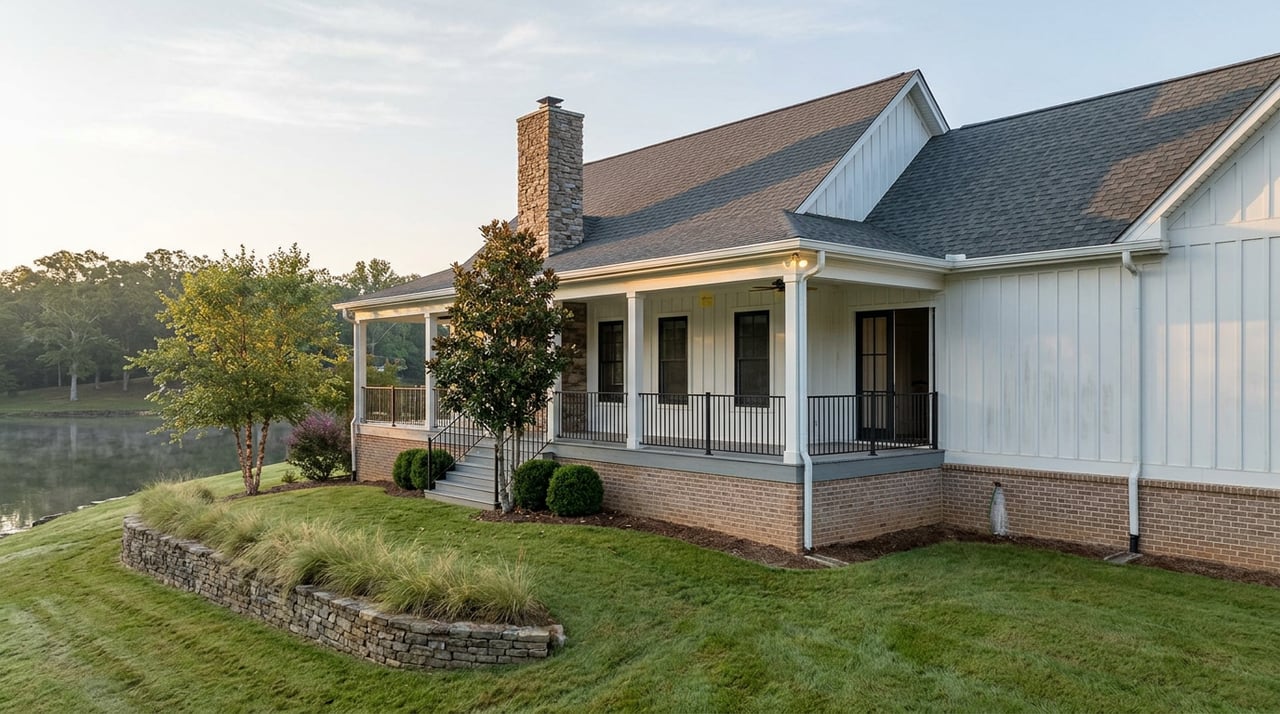
If you have been comparing lake markets by scrolling listing prices, Lake James probably looks like a bargain hunter's dream. A vacant lot in Bear Cliff can list in the high five figures while a finished home three coves over in Old Wildlife Club runs seven figures. The instinct is to treat the cheap lot as a discounted entry point into the same lake life, just with a wait attached.
That comparison stopped holding up on July 1, 2026.
Duke Energy, which owns and manages the lakebed at Lake James under its federal hydro license, changed how it handles private dock applications. The utility will no longer review a dock permit request if there is no home built on the adjoining lot. The rule applies across every Duke Energy lake, not just Lake James, and it only touches new dock applications. Shoreline stabilization requests are unaffected. But for anyone eyeing raw land with the plan to secure water access early and build the house later, the sequence just reversed. You cannot get in line for a dock until the house exists.
That single administrative change is worth understanding before you compare a $93,000 lot to a $1.1 million home on a price-per-acre basis, because it explains a gap that a spreadsheet alone will not show you.
The Sequencing Problem Nobody Priced In
Under the old approach, a buyer could purchase waterfront land, submit a dock application relatively early in the process, and treat the permit as a formality to sort out while construction was underway. Some buyers used that early approval as a selling point when they eventually listed the lot, since a permitted-but-unbuilt dock signaled the water access was already secured.
That option is gone. Duke Energy's own guidance is direct about it: no house, no review. A buyer today has to finish construction first, then submit the dock application, then wait through Duke's review before a single piling goes in the water. Turnaround has historically run several weeks depending on the season and project type, so the dock is now the last piece of the puzzle instead of one you could line up in parallel with the build.
For a buyer weighing land against a finished home, this changes what you are actually purchasing. A finished lakefront home with an existing, permitted dock comes with water access that transfers to you through Duke's Lake Access Permit System, a process that includes a physical inspection to confirm the structure matches what was originally approved. A vacant lot comes with a lower price tag and a longer road to the same result, one that now has a hard stop until the house is standing.
What the Price Gap Between Communities Is Actually Buying
Look at current listing activity across Lake James communities as of early September 2026 and the spread is wide. Bear Cliff sits around $79,000. The Arbor at Lake James runs closer to $93,000. Pisgah Preserve is near $100,000. Compare that to Old Wildlife Club at roughly $1.1 million, Waterglyn near $912,000, or 1780 at about $1.4 million, and the temptation is to read the difference purely as house size or finish quality.
Some of that gap is square footage. But some of it is the dock itself. A home in a community like Old Wildlife Club or Waterglyn typically carries a dock that has already cleared Duke's review, already been tagged during a closeout inspection, and is ready to move to a new owner's name through a straightforward transfer. A lot in Bear Cliff or The Arbor, priced to reflect raw land, does not carry that asset yet. Buying it means you are also buying the obligation to build first and then start a permitting clock that a finished-home buyer never has to run.
This matters most for buyers who assumed the cheaper lots were simply a slower path to the identical outcome. They are not identical outcomes. One comes with a working relationship to the lake already established. The other comes with a construction schedule standing between you and that same relationship.
The Dues Stack Nobody Puts in the MLS Description
Land price and dock timing are not the only numbers that behave differently than expected once you look community by community. Annual dues structures on Lake James vary enough that two lots with similar list prices can carry very different ongoing costs.
In The Arbor at Lake James, 2026 dues run $1,900 a year for a waterfront lot and $2,900 for an interior lot, a figure that includes a deeded boat slip fee. On top of that, every property owner in the community pays a separate, mandatory $4,200 annual membership to Camp Lake James, regardless of whether the lot is waterfront or interior. That is close to $6,000 a year in combined dues for some owners before a single utility bill arrives.
Compare that to Dry Creek, part of the SouthPointe Owners Association, where 2026 dues are $1,140 a year for waterfront and $2,075 for an interior or water-access lot with a boat slip included. Dry Creek owners also pay separate annual inspection fees, roughly $130 to $160 for septic depending on system size and $176.14 for a grinder pump inspection.
Neither number is right or wrong. They are simply different cost structures attached to lots that might otherwise look comparable in a listing photo. A buyer treating HOA dues as a rounding error on a seven-figure purchase is making a different mistake than a buyer doing the same thing on a $93,000 lot, where an extra $4,000 or $5,000 a year in mandatory dues is a much larger percentage of the annual carrying cost.
The Rental Assumption That Doesn't Survive Contact With the HOA
One more detail worth checking before land shopping turns into land buying. Several Lake James communities, including The Arbor, do not allow short-term rentals in most of the community. Buyers coming from markets where a lake lot doubles as a future income property sometimes assume that flexibility exists here by default. It does not, at least not in every community, and it is worth confirming lot by lot rather than assuming.
That restriction pairs with the dock timeline in an important way. If the plan was to buy land, build a modest structure, rent it short-term to offset holding costs while saving for a larger build, and eventually install a dock, the rental restriction removes one leg of that plan before the dock rule even comes into play.
What This Means If You Are Comparing Lake James to Somewhere Else
None of this makes Lake James a worse buy. The lake is fed by the Linville and Catawba Rivers, runs through Burke and McDowell Counties with a Blue Ridge Mountain backdrop, and Lake James State Park alone offers over 25 miles of hiking trails along the shoreline, a combination that Lake Norman or Lake Hickory simply do not replicate. What changes is how you evaluate a listing. The sticker price on a vacant lot is not preview pricing for the same lake-access rights a finished home already has. It is the price of a lot plus a construction timeline plus a permitting process that did not work this way as recently as this past spring.
If you are comparing land to a finished home, ask directly whether an existing dock permit is in place and whether it is currently in the seller's name or still needs a transfer through Duke's system. If you are comparing communities, ask about the full dues stack, not just the HOA line, since a mandatory club membership can double the real annual cost on paper-cheap lots. And if a rental income plan is part of your math, confirm the short-term rental policy for that specific community before you assume it works the way it does elsewhere.
How does the July 2026 rule affect docks that already exist? It does not touch them. The change only applies to new private dock applications where no home has been built yet. Existing, permitted docks on finished homes are unaffected and still transfer through Duke's standard process when the property sells.
Can I still buy vacant land on Lake James and plan to add a dock later? Yes, but the order now runs build first, apply second. Duke Energy will not review a dock application until the house is constructed, so any dock work has to wait until after your build is complete.
If I buy a home with an existing dock, do I need to do anything? Yes. The permit has to be formally transferred into your name through Duke's Lake Access Permit System, and a Lake Services representative inspects the structure as part of that transfer to confirm it matches what was originally approved.
If you are weighing land against a finished home on Lake James, or trying to figure out what a specific community's dues and dock status actually mean for your budget, Osborne Real Estate Group can walk through the numbers with you cove by cove. And if part of your plan involves selling a current home first, get your free home valuation to see what you have to work with before you start comparing lots.